A class representing a channel. More...
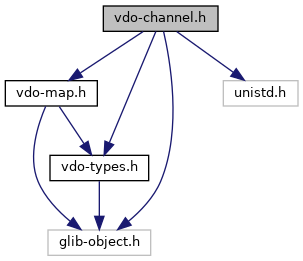
Go to the source code of this file.
Macros | |
| #define | VDO_CHANNEL_GLOBAL NULL |
| Used for accessing info which is global for all channels. | |
Functions | |
| VdoChannel * | vdo_channel_get (guint channel_nbr, GError **error) |
| Get an existing channel. More... | |
| VdoChannel * | vdo_channel_get_ex (VdoMap *desc, GError **error) |
| Get an existing channel matching a description. More... | |
| GList * | vdo_channel_get_all (GError **error) |
| Get all existing channels. More... | |
| GList * | vdo_channel_get_filtered (VdoMap *filter, GError **error) |
| Get all existing channels matching a filter. More... | |
| VdoMap * | vdo_channel_get_info (VdoChannel *self, GError **error) |
| Get the info for this channel. More... | |
| VdoMap * | vdo_channel_get_settings (VdoChannel *self, GError **error) |
| Get the settings for this channel. More... | |
| gboolean | vdo_channel_set_settings (VdoChannel *self, VdoMap *settings, GError **error) |
| Update the settings for this channel. More... | |
| VdoMap * | vdo_channel_get_stream_profile (VdoChannel *self, const gchar *profile, VdoFormat format, GError **error) |
| Query stream profile for the specified name, format and channel. More... | |
| VdoResolutionSet * | vdo_channel_get_resolutions (VdoChannel *self, VdoMap *filter, GError **error) |
| Fetch all valid resolutions for a channel with specified stream format. More... | |
| guint | vdo_channel_get_id (VdoChannel *self) |
| Get the ID of a VdoChannel. More... | |
| gboolean | vdo_channel_set_framerate (VdoChannel *self, gdouble framerate, GError **error) |
| Update the framerate for the specified channel. More... | |
Detailed Description
A class representing a channel.
A vdo channel represents the video from one sensor, or several sensors combined into a composite view. A channel usually corresponds to a "camera" in the VAPIX API. Every vdo stream has a channel as its source.
A VdoChannel object is created in order to retrieve or control a video channel from the VDO service. On ARTPEC-7, ARTPEC-8, Ambarella S6lm and Ambarella CV25 based cameras, the overview channel in the RTSP vapix API, corresponds to the VdoChannel with ID 0. On later platforms (starting with ARTPEC-9), the overview channel is instead the VdoChannel with ID 1. All other channels have sequentially increasing IDs.
The table below shows the supported generic settings for a channel. These settings can be read from a stream via vdo_channel_get_settings. Some settings can also be updated via vdo_channel_set_settings.
A VdoChannel provides the following info. Info is obtained by calling vdo_channel_get_info().
| Name | Type | Description |
|---|---|---|
| "mirror.possible" | boolean | Whether mirroring is possible on this channel |
| "crop.possible" | boolean | Whether crop is possible on this channel |
| "dptz.possible" | boolean | Whether dptz is possible on this channel |
| "available_rotations" | string | Available rotations for this channel |
Copyright (C) 2016-2025, Axis Communications AB, Lund
Function Documentation
◆ vdo_channel_get()
| VdoChannel* vdo_channel_get | ( | guint | channel_nbr, |
| GError ** | error | ||
| ) |
Get an existing channel.
Create a new VdoChannel object representing an existing channel session with the specified channel number.
- Parameters
-
channel_nbr A channel number error A location to return an error.
- Returns
- A VdoChannel or NULL on error. Free with g_object_unref().
◆ vdo_channel_get_all()
| GList* vdo_channel_get_all | ( | GError ** | error | ) |
Get all existing channels.
Create new VdoChannel objects representing each existing channel and return those in a GList.
- Parameters
-
error A location to return an error.
- Returns
- A GList containing VdoChannel objects or NULL on error. Free with g_list_free_full(list, g_object_unref).
◆ vdo_channel_get_ex()
| VdoChannel* vdo_channel_get_ex | ( | VdoMap * | desc, |
| GError ** | error | ||
| ) |
Get an existing channel matching a description.
Create a new VdoChannel object representing an existing channel session matching a description.
The description map must contain exactly one of the following keys:
- view
- warp
- input
- channel
- virtual (deprecated)
where the value is the suffix for the specified type.
For example, get channel object for 'input1':
- Parameters
-
desc A VdoMap specifying a description. error A location to return an error.
- Returns
- A VdoChannel or NULL on error. Free with g_object_unref() or g_autoptr.
◆ vdo_channel_get_filtered()
| GList* vdo_channel_get_filtered | ( | VdoMap * | filter, |
| GError ** | error | ||
| ) |
Get all existing channels matching a filter.
Create new VdoChannel objects representing existing channels matching a filter and return those in a GList.
- Parameters
-
filter A VdoMap specifying filter or NULL for all channels. error A location to return an error.
- Returns
- A GList containing VdoChannel objects or NULL on error. Free with g_list_free_full(list, g_object_unref).
- Examples
- vdo-example-channel-filter.cc.
◆ vdo_channel_get_id()
| guint vdo_channel_get_id | ( | VdoChannel * | self | ) |
Get the ID of a VdoChannel.
- Parameters
-
self The VdoChannel to query.
- Returns
- The id of the channel.
- Examples
- vdo-example-channel-filter.cc.
◆ vdo_channel_get_info()
| VdoMap* vdo_channel_get_info | ( | VdoChannel * | self, |
| GError ** | error | ||
| ) |
Get the info for this channel.
This function is called in order to get a pointer to the info map for this channel. The returned pointer is a pointer to a newly allocated VdoMap owned by the caller of this function. For example:
AXIS OS 12.1 supports VDO_CHANNEL_GLOBAL with the following info.
| Name | Type | Description |
|---|---|---|
| "view.count" | uint32 | The amount of view area channels |
| "warp.count" | uint32 | The amount of warp/dewarp channels |
| "input.count" | uint32 | The amount of sensor/input channels |
| "channel.count" | uint32 | The total channel count |
- Parameters
-
self A VdoChannel. error A location to return an error.
- Returns
- A pointer to a VdoMap owned by this channel, or NULL on error. Free with g_object_unref().
- Examples
- vdo-example-channel-filter.cc.
◆ vdo_channel_get_resolutions()
| VdoResolutionSet* vdo_channel_get_resolutions | ( | VdoChannel * | self, |
| VdoMap * | filter, | ||
| GError ** | error | ||
| ) |
Fetch all valid resolutions for a channel with specified stream format.
Get a VdoResolutionSet of valid resolutions.
- Parameters
-
self The VdoChannel to query. error A location to return an error. filter A VdoMap specifying filter or NULL for default.
| Name | Type | Description |
|---|---|---|
| "format" | uint32 | Video stream format as VdoFormat. |
| "subformat" | string | The subformat for streams in YUV format. |
| "select" | string | Supports: "all", "min", "max", "minmax". |
| "aspect_ratio" | string | Supports: "1:1", "4:3", "5:4", "16:9", "16:10", "native". |
| "pixel.limit" | uint32 | The default pixel limit is tuned per platform (YUV Only). |
- Returns
- A VdoResolutionSet on success, or NULL on error. Free with g_free.
◆ vdo_channel_get_settings()
| VdoMap* vdo_channel_get_settings | ( | VdoChannel * | self, |
| GError ** | error | ||
| ) |
Get the settings for this channel.
This function is called in order to get a pointer to the settings map for this channel. The returned pointer is a pointer to a newly allocated VdoMap owned by the caller of this function. For example:
- Parameters
-
self A VdoChannel. error A location to return an error.
- Returns
- A pointer to a VdoMap owned by this channel, or NULL on error. Free with g_object_unref().
◆ vdo_channel_get_stream_profile()
| VdoMap* vdo_channel_get_stream_profile | ( | VdoChannel * | self, |
| const gchar * | profile, | ||
| VdoFormat | format, | ||
| GError ** | error | ||
| ) |
Query stream profile for the specified name, format and channel.
The combination of profile and format is unique and may have different stream settings.
- Parameters
-
self The VdoChannel to query. profile The name of the stream profile format The format of the stream profile. error A location to return an error.
- Returns
- A pointer to a VdoMap with profile settings, or NULL on error. Free with g_object_unref().
◆ vdo_channel_set_framerate()
| gboolean vdo_channel_set_framerate | ( | VdoChannel * | self, |
| gdouble | framerate, | ||
| GError ** | error | ||
| ) |
Update the framerate for the specified channel.
This function is invoked in order to update the framerate of a channel. All streams that are connected to this channel may be changed. Only streams with a higher fps set than the channel framerate will be affected.
- Parameters
-
self The VdoChannel to set framerate on. framerate A framerate. error A location to return an error.
- Returns
- TRUE on success, FALSE on error.
◆ vdo_channel_set_settings()
| gboolean vdo_channel_set_settings | ( | VdoChannel * | self, |
| VdoMap * | settings, | ||
| GError ** | error | ||
| ) |
Update the settings for this channel.
This function is invoked in order to update the settings of a channel. The caller owns the VdoMap containing the new/updated settings.
- Parameters
-
self A VdoChannel. settings A VdoMap containing new/updated settings. error A location to return an error.
- Returns
- TRUE on success, FALSE on error.